
Your Lactate Threshold Is Not One Number
A lactate step test often ends with one aerobic threshold, one anaerobic threshold and a set of training zones.
What the report rarely shows is how much these results depend on the calculation method.
Using the same test data, established methods such as Dickhuth-IAS, Dmax, OBLA at 4 mmol/l or segmented regression can produce noticeably different lactate threshold estimates.
In the example included in our new tool, the anaerobic threshold ranges from 14.0 to 17.2 km/h. That corresponds to paces between 4:17 and 3:29 min/km — for the same athlete and the same test.
To make these differences visible, we have built a free online lactate step-test analysis tool:
Open the lactate threshold calculator
It is public, requires no account and runs entirely in your browser.
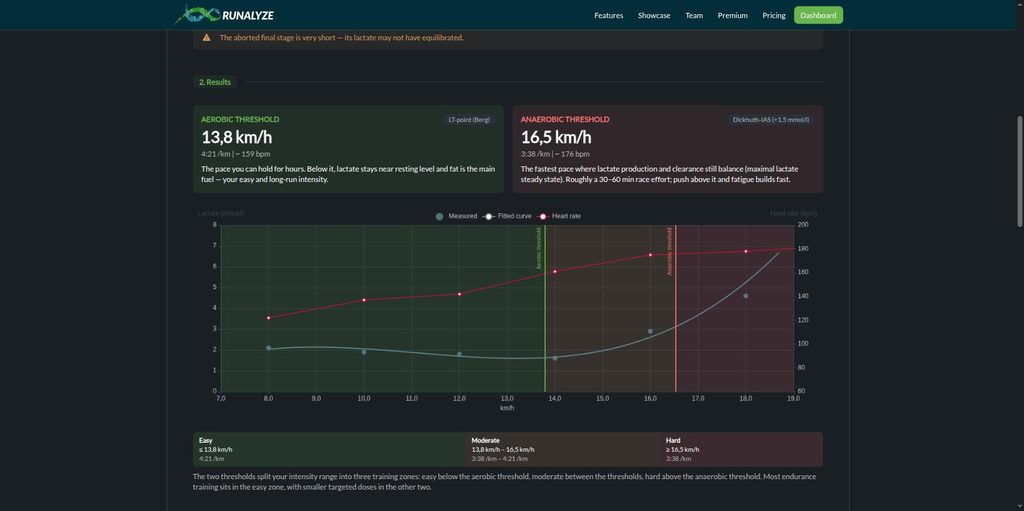
LT1, LT2 and three training zones calculated from the same fitted lactate curve.
Compare 13 lactate threshold methods
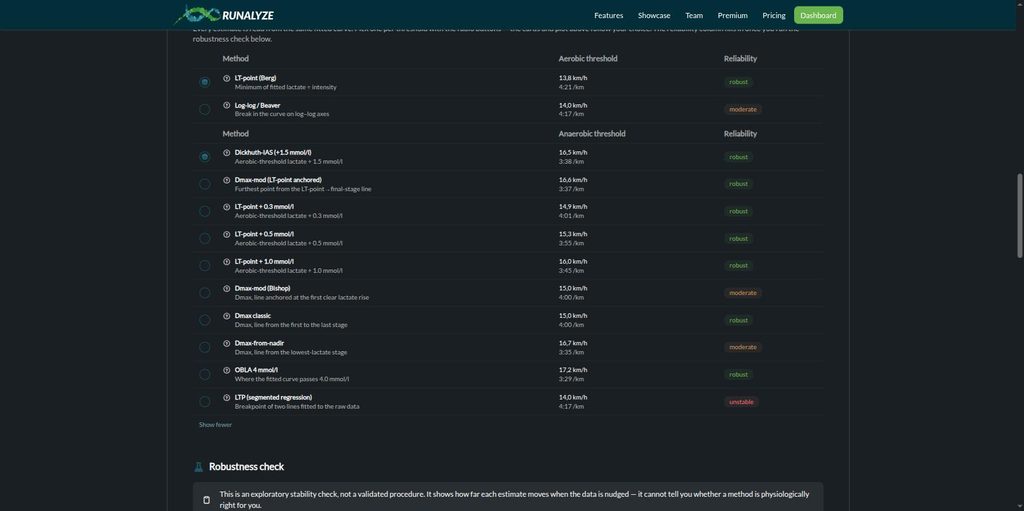
The same step test can produce considerably different threshold estimates depending on the selected method.
Comparing threshold methods is not always straightforward. Different implementations may preprocess the measurements or fit their own lactate curves before calculating a threshold.
Our tool follows one central principle:
Every threshold estimate is derived from the same fitted lactate curve.
This makes the methods directly comparable. Differences between the results come from the threshold definitions rather than from different preprocessing.
The analyser includes 13 methods for estimating LT1 and LT2, including:
- LT-point
- Log-log or Beaver
- LTratio
- Dickhuth-IAS
- Several LT-point offsets
- Modified and classic Dmax variants
- OBLA at 4 mmol/l
- Lactate turn point using segmented regression
Each method includes a short explanation and its original literature reference. You can switch between the methods, and the threshold cards, chart and training zones update immediately.
The tool does not decide which method is physiologically correct for an individual athlete. Instead, it shows how much the result depends on the selected definition.
Enter your lactate step-test data
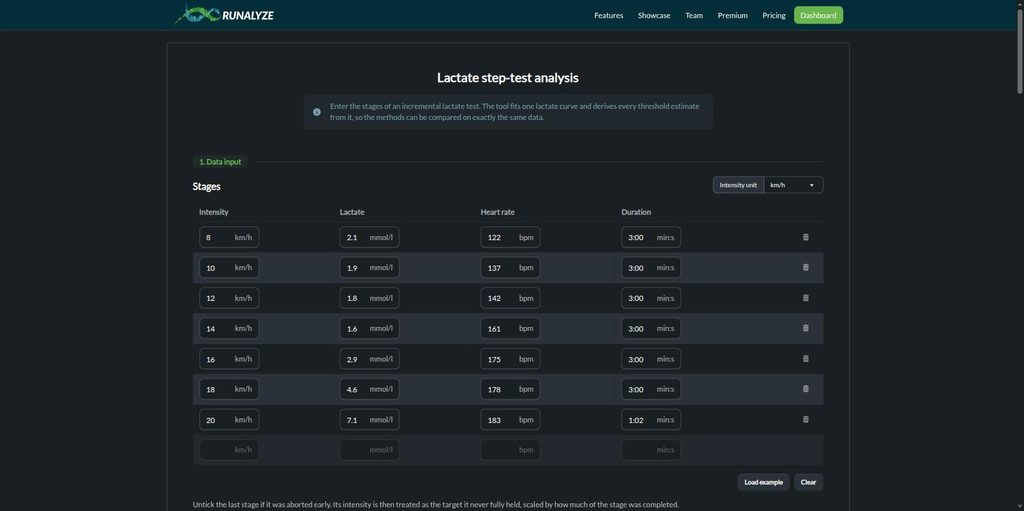
Enter the stages of a running or cycling lactate test, including intensity, lactate, heart rate and duration.
You can enter the stages from an existing laboratory or field test directly into the analyser.
For each stage, add:
- Intensity
- Blood lactate
- Heart rate
- Stage duration
Heart rate is optional, while stage duration is required.
The tool supports both running and cycling tests. Intensity can be entered in km/h, min/km, mph, min/mi, m/s or watts.
Handling an aborted final stage
The final stage of a lactate test is not always completed. Treating it as a fully completed stage could distort the analysis.
You can therefore mark the final stage as incomplete. Its intensity is then scaled according to the fraction of the stage that was actually completed.
Calculate LT1, LT2 and training zones
The result view shows your selected aerobic threshold and anaerobic threshold with:
- Speed, pace or power
- Interpolated heart rate
- A plain-language explanation
- The selected calculation method
Both thresholds are also drawn onto the fitted lactate curve. They divide the intensity range into three training zones:
- Easy: below LT1
- Moderate: between LT1 and LT2
- Hard: above LT2
Heart rate is interpolated between the surrounding test stages rather than independently curve-fitted. This avoids suggesting that a separate heart-rate threshold was measured.
Check how stable each threshold estimate is
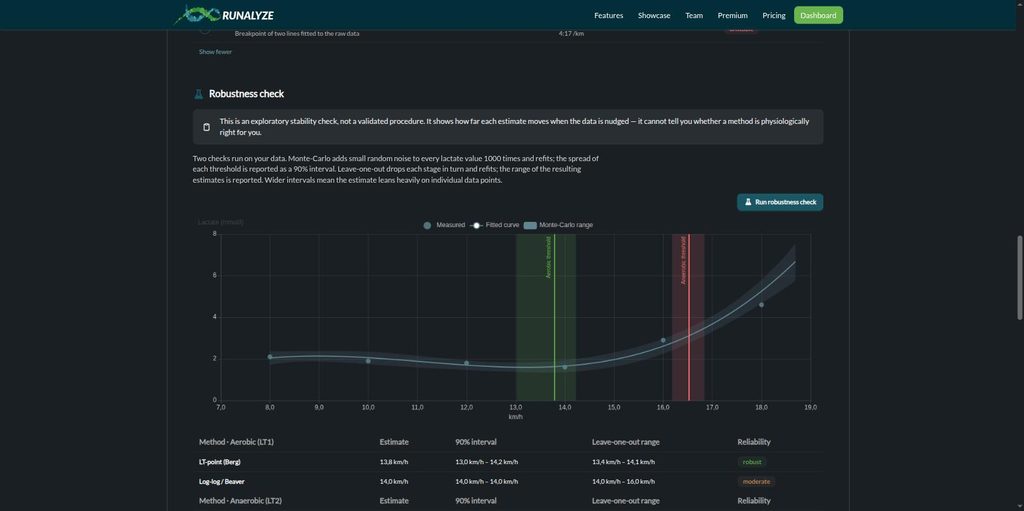
Monte Carlo and leave-one-out checks show how stable each threshold estimate is.
A threshold result can depend heavily on a single measurement or on small variations in the lactate values.
The tool therefore includes two optional robustness checks.
Monte Carlo analysis
The Monte Carlo check performs 1,000 refits with proportional random noise added to the measured lactate values.
It reports a 90 percent interval for every method and shows the plausible envelope of the fitted curve. This provides an indication of how much the result moves when the measurements are slightly altered.
Leave-one-out analysis
The leave-one-out check removes each stage once, refits the curve and recalculates all thresholds.
If omitting one measurement causes a large change, that particular stage has a strong influence on the result.
Each method receives a robust, moderate or unstable label based on these checks.
These labels are an exploratory readability convention. They are not validated physiological cutoffs and do not prove that one threshold method is correct or incorrect.
Plausibility warnings for common test issues
Not every lactate test follows an ideal protocol. The analyser therefore displays warnings for potential issues such as:
- Too few stages
- Strongly varying stage durations
- Insufficient data for the full curve fit
- Lactate continuing to fall at higher intensities
- A very short aborted final stage
- A threshold located at the boundary of the tested range
The warnings do not block the analysis. They provide additional context and identify results that should be interpreted carefully.
Free, private and shareable
The complete lactate step-test analysis runs client-side in your browser.
No account is required, and your test data is not uploaded to RUNALYZE. The entered stages, selected unit and threshold methods can also be stored in the URL, allowing you to share a complete analysis with an athlete, coach or colleague.
The tool is designed for:
- Runners and cyclists who received only one threshold value from a laboratory
- Coaches comparing tests or calculation methods
- Sports scientists and students
- Athletes who want to understand how their training zones were calculated
It estimates thresholds from the supplied data but cannot determine which method best represents the physiology of a particular athlete.
What it can do is make the calculation and its uncertainty visible.
Analyse your lactate step test
Enter your stages, compare 13 threshold methods and see how stable the estimates are.
The lactate threshold calculator is free, public and available without login: